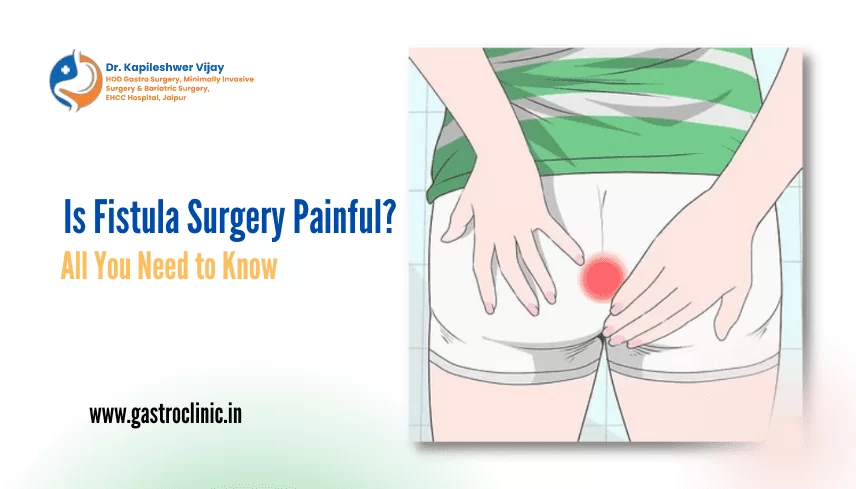
If you have been diagnosed with an anal fistula, the first question on your mind is probably, “Will the surgery hurt?” It is a fair concern. An anal fistula already causes pain, discharge and discomfort, and the thought of an operation in such a sensitive area can feel frightening.
The short answer is that the surgery itself is not painful, because it is done under anesthesia. Some pain after the operation is normal, but it is usually mild to moderate and can be well controlled with medicines and simple care. Modern techniques have also made recovery easier than it used to be.
In this article, we explain what causes pain after fistula surgery, how long it lasts, how to manage it and what to expect from recovery.
An anal fistula is a small tunnel that forms between the inside of the anal canal and the skin around the anus. It usually develops after an anal abscess (a collection of pus) that does not heal properly. Typical signs are repeated pain and swelling near the anus, discharge of pus or blood, skin irritation and, sometimes, fever. To learn the basics, read our guide on what is a fistula, and to recognise the warning signs, see the symptoms of fistula.
Anal fistulas are not common in the general population. They are most often seen in adults in their 30s and 40s, and are more frequent in men. Other conditions, such as Crohn’s disease, previous anal surgery or infections, can also lead to a fistula. Fistulas can also occur in other parts of the digestive tract, and you can read about the causes of a gastrointestinal fistula for more detail.
In most cases, yes. An anal fistula rarely heals by itself, and medicines such as antibiotics may reduce infection and pain for a short time, but they do not close the tunnel. Without treatment, the fistula tends to cause repeated abscesses and can become more complex over time. Surgery is the standard treatment, and you can read more in our overview of fistula surgery.
The best operation depends on where the fistula is and how much of the sphincter muscle (the muscle that controls stool) it passes through. Common options include:
Your surgeon will choose the method after examining you and, if required, doing an MRI or an ultrasound scan to map the tunnel.
During surgery: No. The operation is done under spinal or general anesthesia, and sometimes with local anesthesia in simple cases. You will not feel pain during the procedure.
After surgery: Some pain and discomfort are expected, especially in the first few days. It is usually mild to moderate and is felt around the wound, particularly when you pass stool or sit for long. Most people find that the pain improves steadily over the first week or two. Wounds that are left open to heal can take several weeks to close fully, though they hurt less as time goes on.
Many people go home on the same day or the next day. Light work is often possible within one to two weeks, though this depends on your job and the type of surgery. Full wound healing may take from a few weeks to a couple of months, and complex fistulas may take longer. Your surgeon will give you a timeline based on your case.
Fistula surgery is generally safe, but like any operation it carries some risks:
An experienced surgeon and the right choice of technique greatly lower these risks. Be sure to ask your surgeon about the risk of recurrence and bowel control for your particular type of fistula.
Contact your doctor if you have:
Choosing an experienced surgeon is one of the most important steps in a smooth recovery. If you are looking for a fistula doctor in Jaipur, you can consult Dr. Kapileshwer Vijay, a gastro surgeon who treats anal fistulas. You can read about his background and experience and find details of the fistula surgery in Jaipur offered at Gastro Clinic. Each patient is examined individually, and the technique is chosen to treat the fistula while protecting bowel control and keeping pain and recovery time to a minimum.
To book an appointment, call 6376993553.
1. Is fistula surgery painful?
You will not feel pain during surgery because anesthesia is used. After the operation, there is usually mild to moderate pain, especially in the first few days and during bowel movements. It is controlled with medicines and sitz baths.
2. How long does the pain last after fistula surgery?
Most people notice a clear improvement within one to two weeks. Some tenderness and discharge can continue for a few weeks while the wound heals, depending on the type of surgery.
3. Which type of anesthesia is used for fistula surgery?
It is usually done under spinal or general anesthesia, and sometimes local anesthesia for simple cases. The anesthetist and surgeon will choose the best option for you.
4. Can a fistula heal without surgery?
It is very unlikely. Antibiotics and creams can help with infection and symptoms, but they do not close the tunnel. Surgery is generally needed for a permanent cure.
5. How long does fistula surgery take?
It depends on the complexity. A simple procedure can take 20 to 30 minutes, and a complex one can take an hour or more.
6. Do I need to stay in the hospital?
Many patients go home the same day or after one night. A longer stay may be needed for complex cases or if other medical conditions need monitoring.
7. How long is the recovery after fistula surgery?
Most people return to light work in one to two weeks. Complete healing of the wound usually takes a few weeks to two months, and longer for complex fistulas.
8. Is laser or minimally invasive fistula surgery less painful?
Newer minimally invasive and sphincter-saving techniques are designed to cause less tissue damage, which often means less pain and a faster return to routine. However, they are not suitable for every fistula, and success rates differ. Your surgeon will advise the most suitable method.